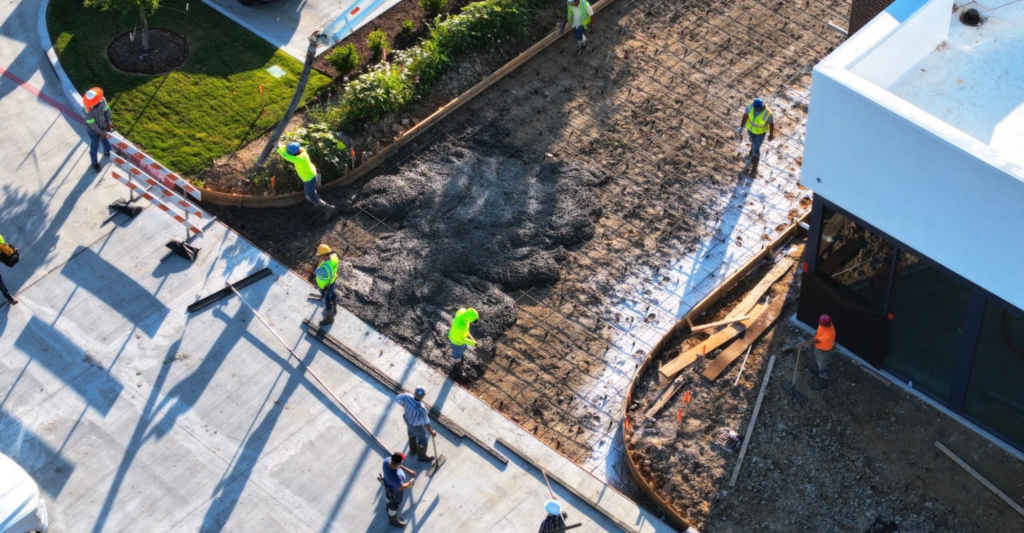
How Much Concrete Do I Need? Understanding Concrete Volume for Your Project

By: Kevin Rios
Last Update: September 2, 2026
Posted In: Residential Builders
Table of Contents
If you’re planning a new driveway, patio, foundation, parking area, or other concrete project, one of the first questions you’re likely to have is:
“How much concrete will I need?”
It’s a fair question, and the answer isn’t always as simple as measuring the size of the area.
Concrete is typically ordered by the cubic yard, and the amount required can vary based on the size and shape of the project, the thickness of the concrete, site conditions, and the project’s specific requirements.
While a basic calculation can give you a general idea, determining the right amount of concrete is something our estimators take into account when preparing a project estimate.
Here’s what you should know.
What Does “A Cubic Yard of Concrete” Mean?
Concrete is commonly sold by the cubic yard, which measures volume rather than surface area.
One cubic yard equals 27 cubic feet of concrete.
That means two projects with the same square footage could require completely different amounts of concrete if they have different thicknesses.
For example, a 1,000-square-foot area poured at 4 inches thick requires less concrete than that same area poured at 6 inches thick.
The size of the project is only part of the equation.
What Determines How Much Concrete a Project Needs?
Several factors go into determining the amount of concrete required for a project.
1. The Size of the Area
Naturally, a larger project requires more concrete.
A small residential walkway may only require a few cubic yards, while a commercial parking area or large slab can require dozens, or even hundreds, of cubic yards.
2. Concrete Thickness
Thickness has a major impact on the total volume of concrete.
A slab designed at 4 inches thick will require significantly less material than the same footprint poured at 6 inches.
However, thicker isn’t automatically better. The appropriate thickness should be based on the intended use, expected loads, site conditions, and project design.
3. The Shape of the Project
Not every concrete project is a perfect rectangle.
Driveways, patios, sidewalks, parking areas, and commercial projects can include:
- Curves
- Angles
- Multiple sections
- Slopes
- Changes in elevation
- Different slab thicknesses
These details can affect the final concrete quantity.
4. Site Conditions
What is happening underneath the concrete matters, too.
Existing grades, excavation, subgrade preparation, drainage, and other site conditions can influence the amount of concrete required to achieve the finished elevations shown in the project plans.
This is one reason an on-site evaluation can be important when determining the final quantity.
5. The Project’s Design and Specifications
A concrete driveway and a commercial warehouse floor may have very different requirements, even if they cover a similar amount of space.
The project’s intended use, anticipated loads, engineering requirements, reinforcement, slab design, and specifications can all influence the final concrete quantity.
How Much Concrete Does a Typical Project Need?
There isn’t one standard amount because every project is different.
But looking at examples can help give you a general sense of scale.
Small Residential Projects
Projects such as:
- Walkways
- Small patios
- Small pads
- Residential flatwork
may require only a few cubic yards of concrete.
Driveways and Larger Residential Projects
A typical driveway can require several cubic yards depending on its dimensions, thickness, design, and site conditions.
A larger driveway with additional approaches, walkways, or other concrete areas will require more.
Commercial Projects
Commercial concrete projects can range dramatically in size.
A project may involve:
- Building slabs
- Foundations
- Parking areas
- Sidewalks
- Curbs
- Equipment pads
- Paving
- Other structural or site concrete
Because of the scale and complexity of these projects, concrete quantities are typically determined from the project plans, specifications, site conditions, and detailed estimating.
Why Can’t You Just Order Based on Square Footage?
This is one of the most common misconceptions about concrete.
Square footage tells you the area, but not the volume.
For example, two 1,000-square-foot slabs don’t necessarily require the same amount of concrete.
One could be 4 inches thick while another is 6 inches thick.
They have the same footprint but different volumes.
And that’s before accounting for things like:
- Grade changes
- Slopes
- Footings
- Thickened edges
- Different slab sections
- Elevations
- Project specifications
That’s why concrete estimating involves more than simply multiplying the square footage of a project.
Why Accurate Concrete Quantities Matter
Getting the concrete quantity right matters for more than just the budget.
Too little concrete
Running short during a concrete pour can create serious logistical problems.
A shortage can mean:
- Additional truck deliveries
- Delays
- Additional labor
- Scheduling complications
- Difficulty maintaining a continuous placement
Concrete placement is time-sensitive, so having the right quantity available is important.
Too much concrete
Ordering significantly more concrete than necessary can also increase project costs and create disposal challenges.
The goal isn’t simply to order more “just in case.”
The goal is to determine the appropriate quantity for the project.
That’s where professional estimating becomes valuable.
What Does a Concrete Estimator Look At?
When Rios Brothers Concrete prepares an estimate, the amount of concrete isn’t determined by looking at one measurement.
Depending on the project, an estimator may consider:
- Project plans
- Site dimensions
- Slab thickness
- Elevations
- Site conditions
- Concrete specifications
- Reinforcement requirements
- Footings and thickened areas
- Access to the site
- Project scope
- Intended use
- Phasing or multiple pours
For commercial construction, this process can become significantly more detailed because the estimator may be working from architectural, structural, civil, and other construction documents.
That’s why a professional estimate is much more useful than a quick online calculation when you’re planning an actual project.
Does More Concrete Mean a Better Project?
Not necessarily.
It’s easy to assume that using more concrete automatically means a stronger or better project.
In reality, concrete performance depends on the entire system.
That can include:
- Proper site preparation
- Appropriate slab thickness
- Reinforcement
- Concrete mix
- Drainage
- Jointing
- Placement
- Finishing
- Curing
- Site conditions
- Intended loads
The goal is to build the project according to its actual requirements—not simply use the most material possible.
What Should I Have Ready When Requesting a Concrete Estimate?
You don’t need to know your exact concrete yardage before contacting a contractor.
That’s what the estimating process is for.
However, it can be helpful to provide:
- The project location
- What you’re looking to build
- Approximate dimensions, if you know them
- Photos of the existing area
- Plans or drawings, if available
- Your desired timeline
- Any specific project requirements
For commercial projects, providing construction plans and specifications can help the estimating team understand the full scope of work.
You don’t need to have all the answers before reaching out.
A good contractor should be able to help identify the information needed to properly evaluate the project.
Frequently Asked Questions About Concrete Quantities
How much concrete do I need?
The amount of concrete required depends on the project’s dimensions, thickness, design, site conditions, and specifications. A professional estimate provides a more accurate quantity than a basic square-foot calculation.
How is concrete measured?
Concrete is typically measured and ordered by the cubic yard, which accounts for the three-dimensional volume of the project.
How many cubic feet are in a cubic yard of concrete?
There are 27 cubic feet in one cubic yard.
Does concrete thickness affect how much concrete I need?
Yes. The thicker the concrete, the greater the volume required for the same surface area.
Can I estimate my concrete needs using square footage?
Square footage can provide a starting point, but it doesn’t account for thickness, grade changes, shapes, footings, or other project-specific requirements.
Does every concrete project require the same thickness?
No. Concrete thickness depends on the project’s intended use, expected loads, design, site conditions, and applicable specifications.
Why is professional concrete estimating important?
Professional estimating considers the complete project rather than relying on a simple surface-area calculation. This can help ensure the appropriate amount of concrete is planned and ordered for the project.
Can Rios Brothers Concrete estimate my project?
Yes. Rios Brothers Concrete works with homeowners, builders, general contractors, developers, and commercial clients throughout North Texas to estimate and complete concrete projects based on their specific requirements.
Planning a Concrete Project?
Whether you’re considering a new residential driveway, patio, foundation, commercial slab, parking area, or another concrete project, you don’t need to figure out the concrete yardage yourself.
That’s where our team comes in.
Rios Brothers Concrete provides concrete services for residential, commercial, and new construction projects throughout North Texas, with estimating and project planning tailored to the specific requirements of each job.
Have a project in mindContact Rios Brothers Concrete to discuss your project and request an estimate.
We build what matters.

Posted In:
Related Blog Articles
- October 6, 2026
Concrete Patio Ideas: 7 Smart Tips for North Texas Backyards
If you’re planning a backyard upgrade in Weatherford, Fort Worth, or...
- September 22, 2026
Tree Trimming or Tree Removal? Signs Every DFW Homeowner Should Know
Deciding between tree trimming and tree removal is one of the...
- September 2, 2026
How Much Concrete Do I Need? Understanding Concrete Volume for Your Project
If you’re planning a new driveway, patio, foundation, parking area, or other...