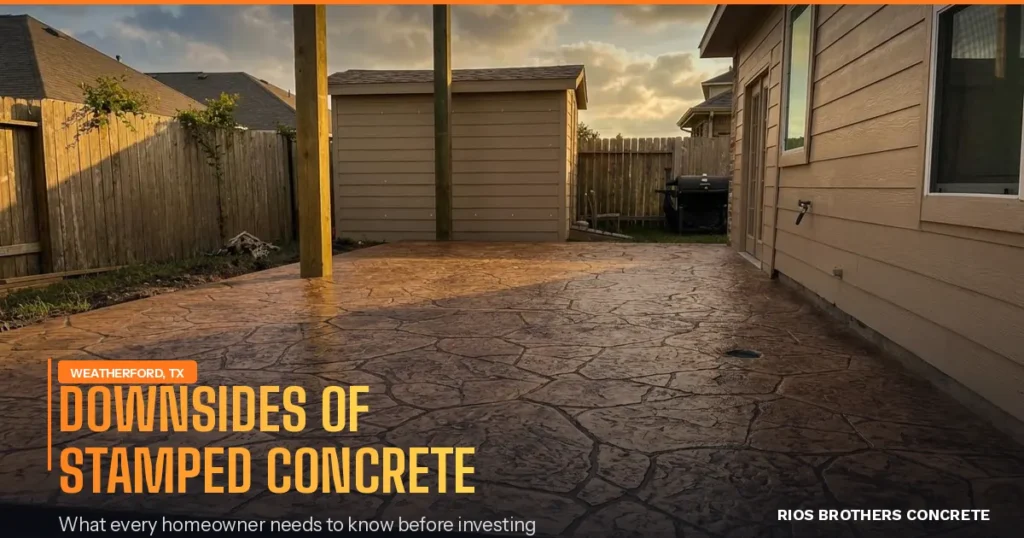
Real Downsides of Stamped Concrete in Weatherford, TX (And How to Avoid Them)

By: Kevin Rios
Last Update: June 6, 2026
Posted In: Commercial, Residential
Table of Contents
Biggest downside of stamped concrete in Weatherford, TX isn’t the price , it’s what happens after the pour. Ongoing sealer maintenance and nearly impossible-to-hide crack repairs catch more Parker County homeowners off guard than the upfront cost ever does. And in this climate, that’s not a small thing. Between the summer heat pushing past 100°F, relentless UV exposure, and the occasional hard freeze, a stamped surface that isn’t properly maintained starts showing its age faster than most people expect.
That said, stamped concrete remains one of the most-requested upgrades we install at Rios Brothers, and honestly, it deserves that reputation. Homeowners in Weatherford, Aledo, Azle, and throughout Parker County choose it for patios, driveways, and pool decks because nothing else gives you that natural stone or brick look at a comparable price point.
I’ve been pouring and maintaining stamped concrete across North Texas long enough to have seen both sides of it. When it’s done right and looked after, it’s a genuinely impressive surface that holds up for decades. When corners get cut… on the base prep, the sealer schedule, or the expansion joints, the problems show up fast, and they’re not cheap to fix.
This guide gives you the honest picture. Every real downside, what causes it, and what you can actually do to avoid it.
What Is Stamped Concrete?
Stamped concrete is a decorative concrete surface that is patterned, textured, or colored during installation to mimic materials like flagstone, slate, brick, cobblestone, or wood. It is applied to a standard poured concrete slab before the concrete fully cures, using rubber or polyurethane stamp mats pressed into the surface.
It’s popular for driveways, patios, pool decks, walkways, and front entries because it offers significant aesthetic improvement over plain gray concrete at a fraction of the cost of natural stone.
That said, the same decorative finish that makes it attractive also introduces a set of maintenance and repair challenges that plain concrete does not have. Here is what Weatherford homeowners need to know.
Downside #1: Cracks Are Nearly Impossible to Repair Invisibly
This is the downside that frustrates homeowners most and it is the one most often glossed over in sales conversations.
All concrete expands and contracts with temperature changes. In Weatherford, where summer highs routinely exceed 100°F and temperatures can drop below 20°F in winter, that thermal movement is significant. Over time, stress cracks the slab. This is normal. On plain concrete, a crack is a crack. On stamped concrete, a crack cuts directly through the color, pattern, and texture… and matching all three during a repair is extremely difficult.
Even experienced contractors cannot guarantee a perfect color or pattern match on a repair. Integral color fades at a different rate than patch material. The stamp mat used years earlier may no longer be available. The result is that most repairs are noticeable if you look for them.
What you can do to reduce this risk:
- Insist on proper subgrade compaction. A poorly prepared base is the #1 cause of premature cracking
- Use control joints (saw cuts) every 8 – 12 feet to direct where minor cracking occurs in predictable, less visible locations
- Ask about fiber reinforcement or rebar to improve slab tensile strength
- Address small cracks early. Minor crack injection is far less visible than a full patch repair
Downside #2: Maintenance Is Non-Negotiable in Texas Heat
Plain concrete can largely be left alone for years. Stamped concrete cannot. The acrylic sealer that protects and enhances the surface color breaks down under the Parker County sun, and skipping resealing accelerates surface degradation significantly.
In Weatherford, plan to reseal your stamped concrete every 2–3 years. High-traffic areas, especially driveways should be resealed closer to every 18–24 months. The cost is manageable (typically $0.75–$1.50 per square foot for professional resealing), but it is a recurring expense that needs to be budgeted.
What sealer maintenance includes:
- Cleaning the surface to remove oil, debris, and biological growth before resealing
- Lightly stripping old sealer buildup every few resealing cycles (typically every 6–8 years)
- Reapplying 2 coats of UV-resistant solvent-based or water-based acrylic sealer
- Re-adding a non-slip additive if the surface is near a pool, steps, or high-traffic walkway
Downside #3: Slippery Surfaces Are a Genuine Safety Risk
A sealed stamped concrete surface has a sheen. That sheen becomes dangerously slick when wet, especially on pool decks, around water features, and on shaded patios that dry slowly.
This is not a flaw in the material itself. It is a flaw in the installation if a non-slip additive was not incorporated into the sealer. Unfortunately, some contractors skip this step to save time or cost and some homeowners only find out after a family member slips.
Always confirm with your contractor that a non-slip aggregate (typically aluminum oxide or shark-grip polymer) will be added to the sealer, especially for pool decks, steps, and driveways with inclines. The National Floor Safety Institute estimates that slip-and-fall accidents account for over 1 million emergency room visits annually; a simple additive eliminates most of that risk on your property.
Downside #4: Colors Fade Under Parker County Sun
UV radiation is relentless in North Texas. Over time, surface color, particularly darker hues like charcoal, deep red, and brown , fades and becomes uneven. The ridges and textured areas of the stamp pattern tend to bleach faster than the recessed areas, which can make the surface look worn or patchy.
This fading accelerates when the sealer is allowed to break down or is not reapplied on schedule. Color can be partially restored during resealing with the addition of a colored sealer or tinted coat, but achieving an exact match to the original color years later is challenging.
According to the Portland Cement Association, UV degradation of surface sealers is one of the leading causes of decorative concrete discoloration in high-sun climates. If color longevity is a priority, choose lighter integral colors , lighter tones show significantly less fading contrast than dark pigments.
Downside #5: Higher Upfront Cost Than Plain Concrete
Stamped concrete costs significantly more than a standard concrete slab. The additional labor for placing color hardener, applying stamps before the concrete sets, and sealing the finished surface adds both time and material cost.
In the Weatherford, TX market, here is a general cost comparison:
| Surface Type | Typical Cost/Sq Ft (TX) | Key Consideration |
| Plain concrete | $6–$10 | Lowest cost; limited visual appeal |
| Stamped concrete | $12–$20 | Best value for decorative look |
| Interlocking pavers | $15–$25 | Individual pieces; easier spot repair |
| Natural stone | $20–$40+ | Premium look; highest cost |
| Asphalt | $4–$8 | Cheapest; frequent upkeep in TX heat |
Note: Prices vary based on project complexity, site prep, and current material costs. Request a free quote for an accurate estimate for your project.
Downside #6: Repairs Require a Skilled Contractor, Not a DIY Fix
Stamped concrete is not DIY-friendly when something goes wrong. Matching color, texture, and pattern requires experience with the specific products used in the original pour. Homeowners who attempt self-repairs with concrete patching compounds or off-the-shelf sealers frequently make the problem more visible.
This means repair costs are higher than plain concrete, and you are dependent on finding a contractor familiar with your specific installation. At Rios Brothers, we document the stamp patterns, color codes, and sealer products used on every job we complete , which makes future maintenance and repairs significantly easier for our clients. See our completed concrete projects to get a sense of the work we stand behind.
Stamped Concrete vs. Alternatives: An Honest Comparison
| Stamped Concrete | Interlocking Pavers | Plain Concrete | Natural Stone | |
| Upfront cost | Moderate | Moderate–High | Low | High |
| Repair ease | Difficult | Easy (replace individual units) | Easy | Moderate |
| Maintenance | Reseal every 2–3 yrs | Occasional re-leveling | Minimal | Periodic sealing |
| Lifespan (maintained) | 25–30+ years | 30+ years | 30+ years | 50+ years |
| Slip resistance | Requires additive | Good texture naturally | Good | Varies |
| Aesthetic range | Very wide | Wide | Limited | Very wide |
The right surface depends on your priorities. Stamped concrete wins on value-per-square-foot aesthetics. Pavers win on repairability. Natural stone wins on longevity if budget allows. Plain concrete wins on pure cost. For a deeper look at how plain concrete compares, see our post on the downside of a concrete driveway.
The Weatherford, TX Climate Factor
Many stamped concrete resources are written for general audiences. The Parker County climate introduces specific considerations that make local expertise important:
- Extreme heat (100°F+ summers): Accelerates sealer breakdown. Sealers should be reapplied on the shorter end of manufacturer recommendations here.
- Expansive clay soils: Common in the Weatherford area. Clay shrinks and swells with moisture changes, which stresses the concrete slab from below. Proper base preparation and drainage are critical.
- Occasional hard freezes: Parker County does see hard winter freezes. Freeze-thaw cycles can penetrate unsealed or poorly sealed concrete surfaces and accelerate cracking.
- High UV index: Weatherford’s sun exposure is significantly more intense than northern U.S. markets, which means color fade and sealer degradation happen faster.
None of these factors make stamped concrete a bad choice , they simply mean that proper installation with correct base prep, joint placement, fiber reinforcement, and UV-resistant sealers matters more here than in milder climates. For context on why timing matters, our guide on the best time of year to pour concrete in North Texas goes deeper on seasonal planning.
What Makes a Good Stamped Concrete Installation in Weatherford
After installing stamped concrete across the Weatherford area for years, here is what we consistently see separating projects that hold up from those that develop problems early:
- Subgrade preparation: At least 4 inches of compacted base material, graded for drainage. Expansive clay must be addressed, not ignored.
- Control joints: Properly placed saw cuts placed within 24 hours guide where minor cracking occurs. They should align with corners, doorways, and natural stress points.
- Fiber reinforcement: Polypropylene fiber mixed into the concrete reduces surface crazing and minor shrinkage cracking.
- High-quality color hardener: Broadcast color hardener applied at the right rate produces more durable, consistent color than straight pigment alone.
- Non-slip sealer: Always required for pool decks, inclined driveways, and exterior steps.
- Documented color and stamp records: So future repairs and resealing can be handled without guesswork.
The American Concrete Institute recommends a minimum 4,000 PSI mix design for decorative exterior flatwork in climates with temperature extremes , a standard we follow on every pour.
FAQs: Stamped Concrete Downsides in Weatherford, TX
How soon do cracks appear in stamped concrete in Weatherford?
Minor shrinkage cracks can appear within the first few weeks in North Texas heat. Major structural cracking is rare for many years when installed on a properly compacted base with correct expansion joints.
Can you re-stamp a cracked section?
No. Once concrete cures, the stamp pattern is permanent. Damaged sections can be patched or resurfaced, but matching the existing pattern and color exactly is extremely difficult.
Is stamped concrete more expensive than regular concrete?
Yes, typically 20–40% more due to the added coloring, patterning, and labor. In Weatherford, TX, expect $12–$20 per square foot for stamped vs. $6–$10 for plain.
How often does stamped concrete need to be sealed in Texas? Every 2–3 years at minimum. The intense Parker County sun and summer heat accelerate sealer breakdown. High-traffic driveways may need resealing closer to every 18–24 months.
What is the best stamped concrete pattern for a Weatherford, TX patio?
Flagstone and slate patterns are popular locally because they complement the Texas aesthetic. Ashlar slate is a durable, slip-resistant choice for outdoor patios exposed to rain.
Does stamped concrete add home value in Parker County?
Yes. A professionally installed stamped concrete driveway or patio improves curb appeal, which positively impacts appraisal value and buyer perception in the Weatherford and Parker County real estate market.
Is stamped concrete safe around a pool?
It can be, provided the contractor adds a non-slip aggregate or shark-grip additive to the sealer. Without this, a sealed stamped surface becomes dangerously slick when wet. Always confirm this with your contractor before the job starts.
The Bottom Line: Is Stamped Concrete Worth It in Weatherford, TX?
For most Weatherford homeowners, yes , with clear expectations. Stamped concrete delivers a genuinely attractive, durable surface at a price point that alternatives like natural stone or high-end pavers cannot match. The downsides are real, but they are manageable when you work with a contractor who prepares the site properly, uses quality materials, and gives you a clear maintenance plan upfront.
The projects that disappoint homeowners are almost always the result of one of three things: inadequate base preparation, skipped or delayed sealing, or unrealistic expectations about crack repair.
If you go in, budget for periodic maintenance, and hire a contractor with a documented track record in North Texas conditions, stamped concrete is a smart investment that can enhance your property for 25 years or more.
Ready to get an honest quote for your stamped concrete project in Weatherford or Parker County? Our residential concrete services cover driveways, patios, pool decks, walkways, and more. Call us at (817) 694-7467 or request a free estimate , we will walk you through every option and give you a straight answer on what fits your property and budget.

Posted In:
Related Blog Articles
- September 22, 2026
Tree Trimming or Tree Removal? Signs Every DFW Homeowner Should Know
Deciding between tree trimming and tree removal is one of the...
- September 2, 2026
How Much Concrete Do I Need? Understanding Concrete Volume for Your Project
If you’re planning a new driveway, patio, foundation, parking area, or other...
- August 17, 2026
Concrete vs. Asphalt Driveway in Texas: Which Is Better?
If you’re planning a new driveway in Weatherford, Fort Worth, or anywhere...